Why Is My Blood Sugar High in the Morning When I Didn't Eat?

If your blood sugar is high in the morning when you didn't eat anything, the sugar did not come from food. It came from your own liver. Between roughly 3 and 8 a.m., hormones tell the liver to release stored glucose while your muscles and tissues become less responsive to insulin. In a healthy body, insulin cancels that out. When insulin response is sluggish, the overnight release shows up as a high fasting number, no matter how carefully you ate dinner.
You stopped the bedtime snack. You ate dinner by six. You went to bed hungry on purpose. And the first number of the day still reads 140, 150, sometimes higher than the one you saw after dinner.
If you keep asking why your blood sugar is high in the morning when you didn't eat, you are asking one of the most searched blood sugar questions there is, and one of the worst answered. Most of what you read stops at a name for it. Very little explains why the usual fixes at the dinner table so rarely move the morning number.
Does this sound like your mornings?
- Your fasting number is higher than your bedtime number, even with nothing to eat in between
- Post-meal readings improved with diet changes, but the morning reading never did
- You wake up between 3 and 5 a.m. and cannot fall back asleep
- You feel foggy and flat for the first hour, even after eight hours in bed
- Your doctor keeps pointing to the morning number at every visit
If you checked two or more, you are not doing something wrong at dinner. The problem is happening hours later, while you sleep.
What happens at 3 a.m. while you sleep
A review published this summer in Acta Diabetologica (July 30, 2026) lays out the conventional picture of what doctors call the dawn phenomenon. In the early morning hours your body releases cortisol, growth hormone and adrenaline-type hormones to get you ready to wake up. Those hormones do two things at once: they push the liver to produce more glucose, and they make the rest of your tissues less sensitive to insulin.
Read that twice, because it explains everything that follows. The sugar in your morning reading did not come from the snack you skipped. It came out of storage, from your liver, on a schedule set by your hormones, and it arrived at the exact time of day your cells are worst at taking it in.
Your morning number is not a report on last night's dinner. It is a report on how well your body answered its own overnight sugar release.
The same review notes that people with this pattern tend to see bigger swings across the whole day, not only at breakfast. That is why the morning number matters: it is often the first place a sluggish insulin response shows itself.
What people try, and why it only goes so far
Every reader who writes to us about this has already tried the obvious steps. Some of them help. None of them reach 3 a.m.
- Skipping the bedtime snack. It can lower a high bedtime number. But the liver's release is not fed by the snack, so the morning reading often stays the same. A few readers even saw it go up.
- Eating dinner earlier. A good habit for post-meal spikes. It does nothing about the hormone signal that fires hours later.
- Apple cider vinegar before bed. It may soften the rise from a meal. The overnight release is not a meal.
- A longer evening walk. Walking works while your muscles are working. By 3 a.m. you have been still for hours.
- A cinnamon capsule from the pharmacy. Some people feel it helps a little. Most tell us they could not see it on the meter.
Each of these can work on the part of the problem that comes from food. The morning number is mostly the part that does not.
The piece most advice leaves out
Think of it as two valves. One is the liver's tap, which opens a little before dawn no matter what you do. The other is the door on your cells, which is supposed to open when insulin knocks and let that sugar out of the bloodstream.
You cannot turn off the tap. It is supposed to open; it is how you have the energy to get out of bed. What decides your morning number is how well the door answers. In a body with good insulin response, the extra sugar slips through and the meter reads normal. In a body where the door has grown slow, the sugar waits in the bloodstream until breakfast, and you read it as a high fasting number.
That is why the readers who finally see their morning number move are rarely the ones who cut dinner even further. They are the ones who start supporting how their cells respond to insulin around the clock, including the hours they are asleep. One of them told us how he got there.
Gary's mornings
Gary is 67, a retired school bus mechanic in Ohio, and for most of last year he kept the same notebook on the kitchen table: date, time, number. Every morning the number started with a one and a four or a one and a five.
He did what he read. He stopped the bowl of cereal at 9 p.m. He moved dinner to 5:30. He drank vinegar in water before bed for six weeks and, in his words, "learned to hate salad dressing for no reason." He tried a cinnamon capsule from the drugstore. His after-dinner numbers got a little better. The morning number did not move at all, and at two appointments in a row his doctor circled it with a pen.
"That pen circle was the worst part," he wrote to us. "I was doing everything right at night and getting graded on something I couldn't even see happening."
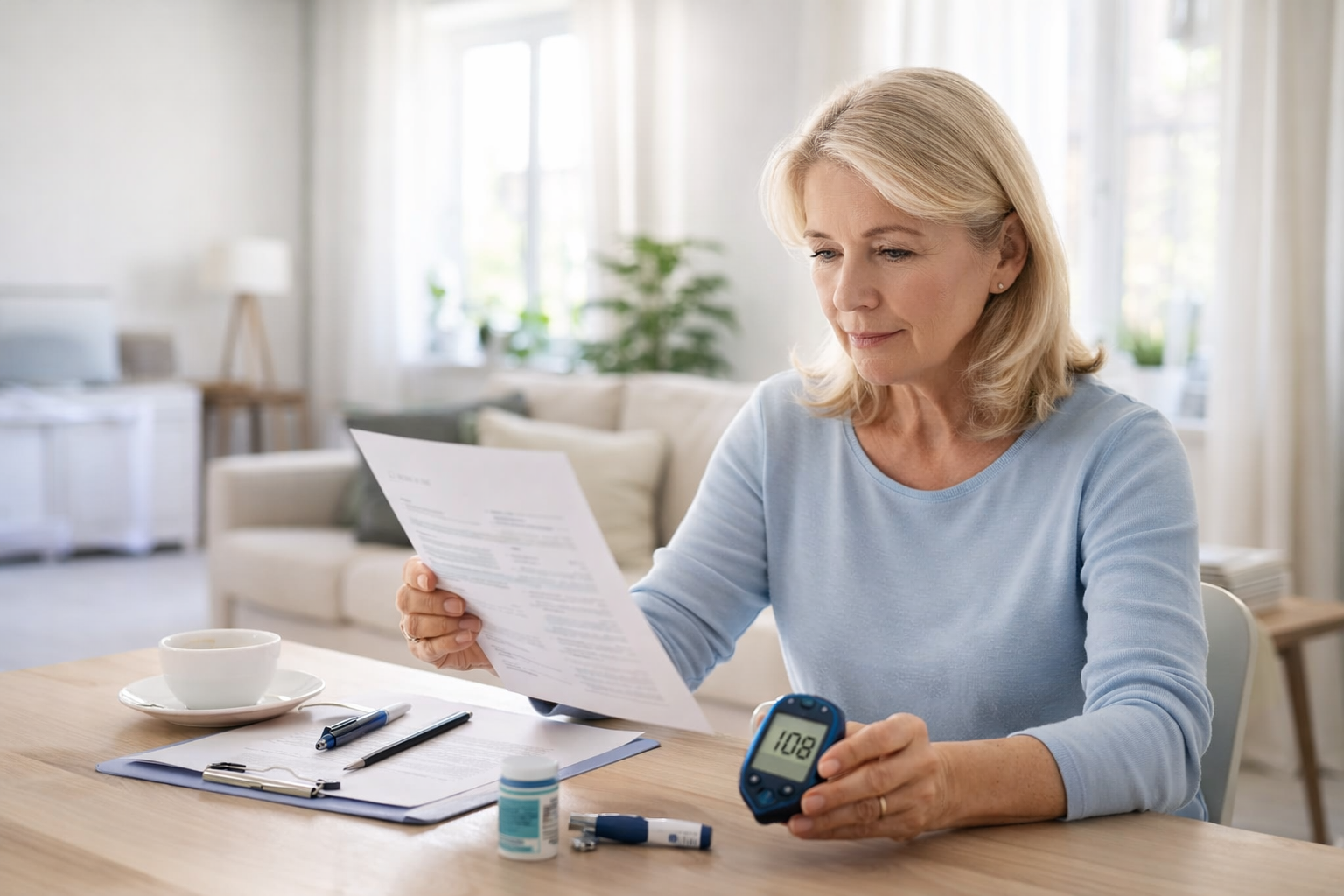
The turn came at his sister Linda's dining table in July. Linda had been fighting the same morning number for two years. That afternoon she slid a sheet of her readings across to him, the last month circled in green instead of red, and then reached into her purse and set a small amber dropper bottle on the table.
Gary's first reaction was the one most of us would have. "A liquid? From the internet? Linda, come on." He picked it up mostly to prove a point. The label was blue and red and said three things: support blood sugar, boost metabolism, improve energy. He turned it around looking for the catch.
The bottle was Free Sugar Pro.
What stopped him from putting it back down was not the label. It was Linda's sheet. She had not changed her diet or her prescription in that month, and he knew it, because they compare notes every Sunday. The only new thing on her kitchen counter was that bottle.
He still did it his way. He wrote the name in his notebook, looked up the company's site that night, and noticed that it describes a proprietary blend of plant ingredients, with chromium shown on the product art, rather than printing a full ingredient list. That bothered him enough that he took the bottle Linda gave him to his pharmacist and asked her to read the panel on the side and check it against his metformin. She found nothing that clashed, told him chromium is a mineral tied to how insulin works, and said what pharmacists always say: tell your doctor and keep checking your numbers.
The last thing that decided it was the guarantee. The company's page shows a 60-day money-back guarantee. "Two months is exactly how long it takes my doctor to see a trend," he told us. "If it did nothing, I'd be out nothing."
What Gary saw, and how long it took
- Week 1. Nothing on the meter. Same 140s and 150s. He almost stopped, and Linda told him she had seen nothing her first week either.
- Weeks 2 and 3. The first reading under 130 he had written in months, then a 141, then a 127. Not a straight line, but a different neighborhood. He noticed he was sleeping through the 4 a.m. wake-up some nights.
- Month 1. His morning average was down several points, and the foggy first hour was shorter. He started making coffee because he wanted it, not because he needed to wake up.
- Months 2 and 3. At his next appointment his doctor flipped through the notebook and did not reach for the pen. Nothing about his prescription changed. "Keep doing what you're doing," she said, and this time he knew what that was.
Why so slow? Because what decides your morning number, how well your cells answer insulin, changes over weeks, not overnight. A single good morning means little; a month of them means something. That is the reason Gary's second order was the three-bottle supply, and why most readers who stick with this give it at least two to three months before they judge. Individual results vary.

Everything Gary wanted to know before he tried it
What it is
Free Sugar Pro is a liquid supplement, a 2 fl oz (59 mL) dropper bottle, made in the United States. The company describes it as a natural, non-GMO, gluten-free, non-habit-forming formula designed to support healthy blood sugar levels, metabolism and daily energy. It is a supplement, not a medication, and it does not replace one.
Why it fits the morning problem
Everything in this article comes back to one idea: you cannot stop the liver's overnight release, but you can support how well your cells answer insulin when it happens. That is what this formula is aimed at, and that is why Gary chose it over another evening trick. It works on the door, every hour of the day, including the ones you sleep through.
What is inside
The company's site calls it a proprietary blend of plant ingredients, and the one ingredient it spells out on the product art is chromium, a trace mineral that helps insulin do its job, which is the door itself. The site does not print a full supplement facts panel, so do what Gary did: read the panel on the bottle when it arrives, and show it to your pharmacist if you take any blood sugar medication.
How to take it
The company recommends 1 mL a day, taken directly or mixed into water. Gary takes his with his morning coffee, after he writes down his number, so the notebook shows him what changed and when. He kept every prescription exactly as written.
Who it may suit, and who should not use it on their own
It may suit you if your morning number is the one that will not move, your post-meal readings respond to diet but your fasting reading does not, and you want to support how your body handles its own overnight sugar alongside your current plan, not instead of it.
Talk to your doctor first if you have type 1 diabetes, take insulin or a sulfonylurea, are pregnant or nursing, or are under 18. If your morning readings regularly run well above target, or come with thirst, frequent urination or blurry vision, that is an appointment before it is a purchase. And never change a medication without medical supervision.
The guarantee
The order page shows a 60-day, 100% money-back guarantee, and the company's returns policy gives you 60 days from purchase to request a refund. That is the window Gary gave himself: two months of notebook pages, and his money back if the meter said no.
You can't stop the 3 a.m. release. You can support how your body answers it.
See the dropper Gary keeps by his notebookIf you are tired of being graded on a number you cannot see happening, the cost of finding out is two months and a notebook. Most readers start with the larger supply for the same reason Gary reordered it: the morning number changes over weeks, and running out in the middle tells you nothing.
One small serving a day, 60 days to judge it, and a refund if your morning number says no.
Start your own 60-day morning testP.S. Gary still eats dinner at 5:30 and still skips the cereal. The difference is the number he writes down at 6:40 a.m. If yours started with a one and a five again today, after a night you did everything right, look at what his sister put on the table.
Further Reading
Walking After Meals but Blood Sugar Still High?
What the 15-30% number leaves out
Blood Sugar Spikes After Meals
What drives the rise and how long it should last
Source: Wang Y, et al. The dawn phenomenon in diabetes: pathophysiology from periphery to central nervous system and circadian rhythm-based therapeutic strategies. Acta Diabetologica, published online July 30, 2026.
Medical Disclaimer: This article is for informational purposes only and does not constitute medical advice. Reader accounts are individual experiences; results vary. Statements about supplements have not been evaluated by the Food and Drug Administration, and supplements are not intended to diagnose, treat, cure or prevent any disease. Always consult a qualified healthcare provider before making changes to your diabetes management, medications, or supplement regimen.